
No products in the basket.
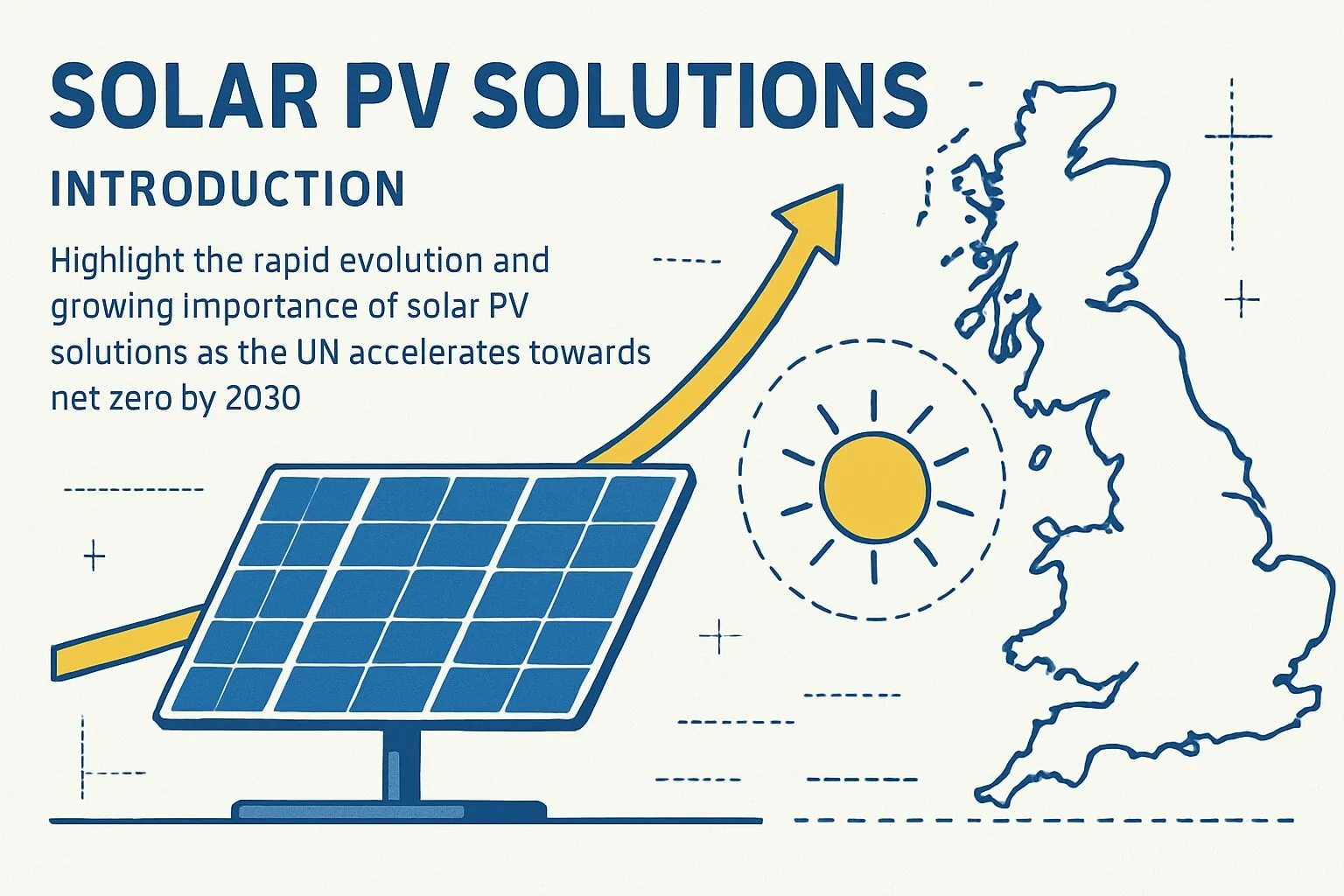

The UK is witnessing a surge in demand for solar pv solutions as the race to achieve net zero by 2050 accelerates. Rapid technological advances and shifting regulations mean the solar landscape is changing faster than ever.
This expert guide delivers a clear, practical overview of the latest trends, technologies, and best practices for solar pv solutions in 2026. Whether you are a business leader, property owner, or sustainability professional, you will find actionable insights to inform your decisions.
Cutting energy costs and carbon emissions is now an urgent priority. Next-generation solar pv solutions offer significant financial, operational, and environmental benefits. With new innovations and government incentives, your return on investment can reach new heights.
Read on to explore the UK market, the newest technologies, solution types, a step-by-step implementation guide, financial considerations, and emerging trends. Unlock the potential of solar pv solutions for a sustainable future.
The landscape for solar pv solutions in the UK is rapidly transforming as the country strives to meet its ambitious net zero targets. By 2026, solar has shifted from an emerging technology to a mainstream energy solution, reshaping how businesses, the public sector, and homeowners approach sustainability and energy management.
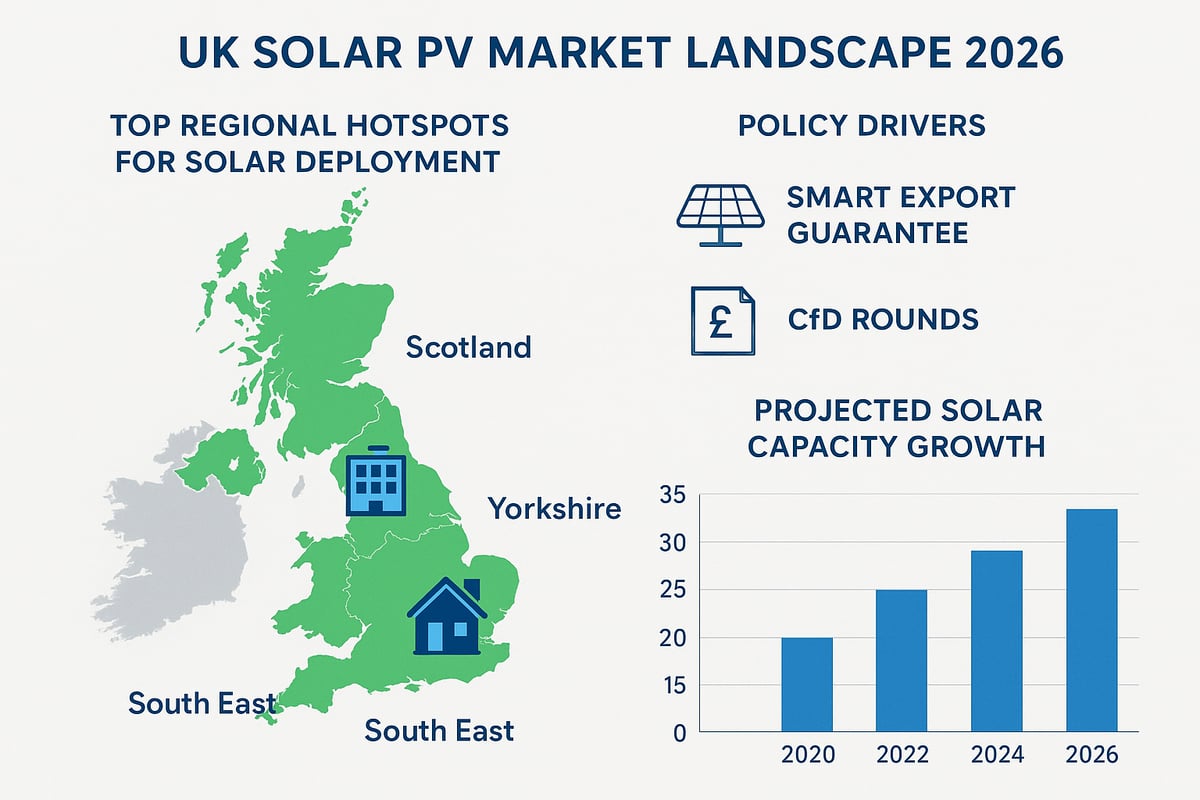
Solar pv solutions are witnessing unprecedented growth in the UK, driven by a convergence of economic, environmental, and regulatory factors. Industry forecasts suggest the nation will reach over 27 GW of installed solar capacity by 2026, with the government targeting an ambitious 47 GW by 2030. For more on these projections and policy context, see the UK solar capacity projections for 2026.
Key demand drivers include volatile energy prices, the urgent need to cut carbon emissions, and the decarbonisation of the grid. Businesses are increasingly turning to solar pv solutions to hedge against energy market fluctuations and demonstrate their commitment to net zero.
Adoption is expanding across sectors. Commercial premises, public sector buildings, industrial estates, and residential properties are all embracing solar pv solutions. The commercial sector, in particular, is responding to investor and stakeholder pressure to bolster ESG credentials.
Regional hotspots such as Yorkshire, the South East, and Scotland are leading deployment, supported by local authority initiatives and favourable grid infrastructure. A prime example is the Yorkshire Building Society’s solar carport project, which showcases how solar pv solutions can deliver both operational savings and sustainability outcomes for large-scale sites.
The regulatory environment is evolving to facilitate the integration of solar pv solutions at scale. Planning permissions for rooftop and ground-mounted systems have been streamlined in many regions, although grid connection requirements remain a key consideration for larger arrays.
Building regulations, such as updates to Part L, increasingly favour renewable energy integration, requiring new builds and major refurbishments to include solar pv solutions or other low-carbon technologies. By 2026, a significant proportion of new developments will be mandated to incorporate renewables, driving further market momentum.
Government grants, the Smart Export Guarantee, and Contracts for Difference (CfD) rounds continue to provide financial incentives for solar pv solutions. Tax benefits and capital allowances are also encouraging investment, especially for businesses seeking to enhance ROI.
Local authorities are embedding sustainability mandates into procurement frameworks, making solar pv solutions a priority for public sector projects. The NHS and education sectors offer leading examples, with many Trusts and schools adopting solar to reduce energy costs and emissions while meeting stringent reporting standards.
In summary, the UK solar pv solutions market in 2026 is defined by robust growth, progressive policy support, and a broadening base of adopters. Understanding these trends is crucial for stakeholders aiming to capitalise on the opportunities presented by the evolving solar landscape.
The landscape for solar pv solutions in 2026 is defined by rapid advances in efficiency, digital controls, and integrated design. These innovations are transforming how businesses and property owners approach energy generation, making solar pv solutions more reliable, versatile, and cost-effective than ever before.
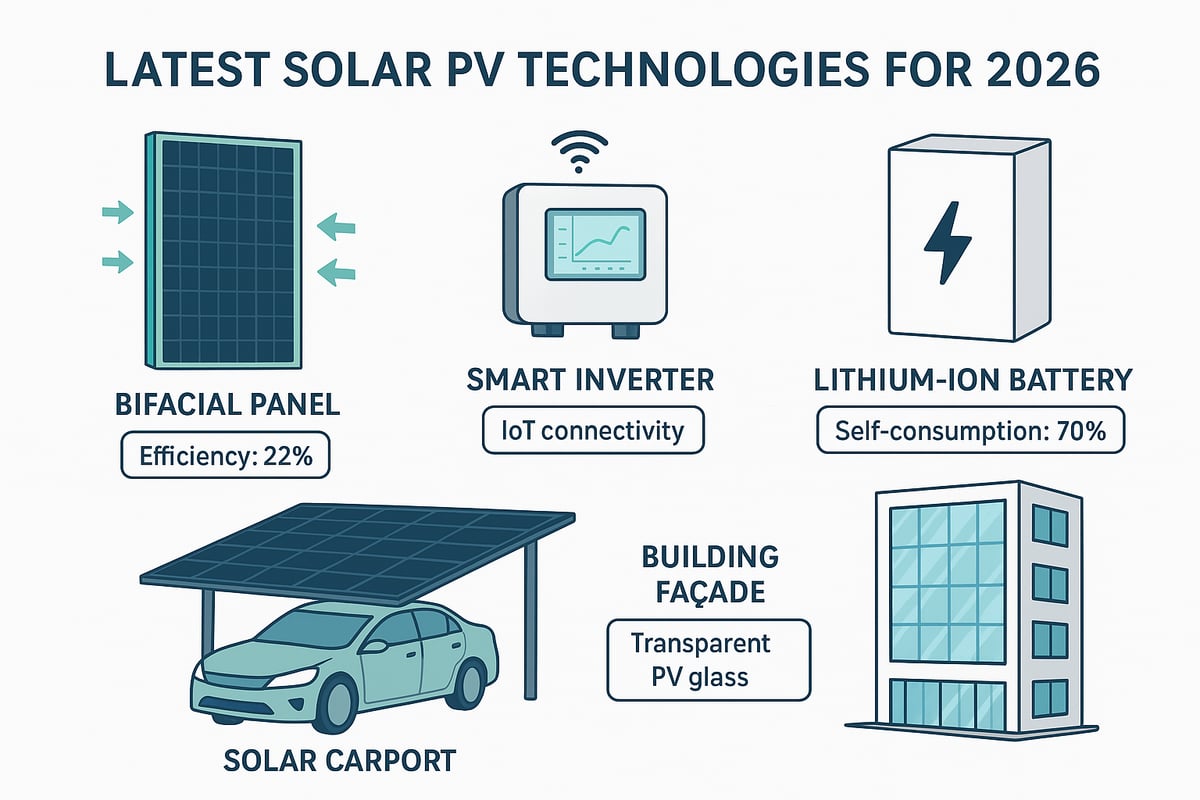
In 2026, the backbone of solar pv solutions is high-performance panel technology. Monocrystalline and bifacial panels have surpassed 22% efficiency, setting new benchmarks for output per square metre. These panels now feature advanced anti-reflective coatings, improved cell architecture, and robust backsheets, which together enhance both their longevity and output.
Leading Tier 1 manufacturers are offering panels with degradation rates as low as 0.25% per year, and warranties extending up to 30 years. This translates to more predictable long-term returns and lower maintenance demands. The use of bifacial modules, which capture sunlight from both sides, is particularly beneficial for commercial sites with reflective surfaces or elevated mounting.
Selecting the right panels is a critical step for any solar pv solutions project. By choosing high-efficiency modules, businesses can maximise yield from limited roof space and achieve faster payback periods.
Modern solar pv solutions are increasingly defined by intelligent electronics. Smart inverters play a central role, converting DC to AC while enabling real-time monitoring and export control. These inverters integrate seamlessly with Building Management Systems (BMS) and IoT platforms, providing granular data on energy flows and performance.
Key benefits include:
By 2026, the majority of commercial solar pv solutions feature advanced monitoring, allowing property managers to optimise self-consumption and quickly address issues. This shift towards data-driven operations underpins greater reliability and ensures that systems perform at their best throughout their lifespan.
Battery storage has become an essential component of modern solar pv solutions. Lithium-ion batteries remain dominant, but flow batteries and new chemistries are gaining ground for their scalability and long cycle life. These technologies support load shifting, peak shaving, and can increase self-consumption rates to as much as 90%.
For sectors like healthcare and education, pairing solar pv solutions with battery storage ensures critical loads remain powered during grid outages and reduces reliance on fossil fuel backup. To explore the latest options available, see Solar battery storage options.
Key benefits of storage integration:
As more organisations seek to future-proof their energy strategy, combining solar pv solutions with storage is a clear pathway to maximise operational and financial benefits.
Innovations in solar canopies and carports are redefining how parking and public spaces are utilised. These structures generate clean electricity while providing shade and weather protection. The modular nature of solar canopies makes them ideal for commercial car parks, retail sites, and transport hubs.
Building-Integrated Photovoltaics (BIPV) are also gaining traction in new builds and refurbishments. Options include solar tiles, facade panels, and transparent PV glass, enabling architects to seamlessly blend energy generation with design aesthetics.
Comparing ROI:
| Solution Type | Typical ROI Period | Key Benefit |
|---|---|---|
| Rooftop PV | 5-8 years | Utilises existing space |
| Ground-Mount | 6-10 years | Scalable for large projects |
| BIPV | 8-12 years | Integrated, aesthetic appeal |
By adopting these advanced solar pv solutions, property owners can enhance both the value and sustainability profile of their assets.
The real power of solar pv solutions emerges when they are combined with other technologies. Hybrid systems that partner solar PV with heat pumps, EV charging infrastructure, or solar thermal units deliver a holistic approach to decarbonisation.
Local authorities are leading the way with multi-technology estates, leveraging solar pv solutions alongside battery storage and smart controls to create flexible, low-carbon energy systems. Whole-building strategies are increasingly common, ensuring that every aspect of energy use is optimised for efficiency and sustainability.
As the market evolves, integrating solar pv solutions with complementary technologies will be essential for achieving net zero goals and unlocking the full value of renewable energy investments.
The landscape of solar pv solutions in 2026 is more diverse and adaptable than ever. As technology advances, organisations and property owners can choose from a range of systems tailored to their needs, site characteristics, and sustainability goals.
From traditional rooftop installations to innovative building-integrated options, each solution offers unique benefits. Understanding these types is essential for selecting the right approach.
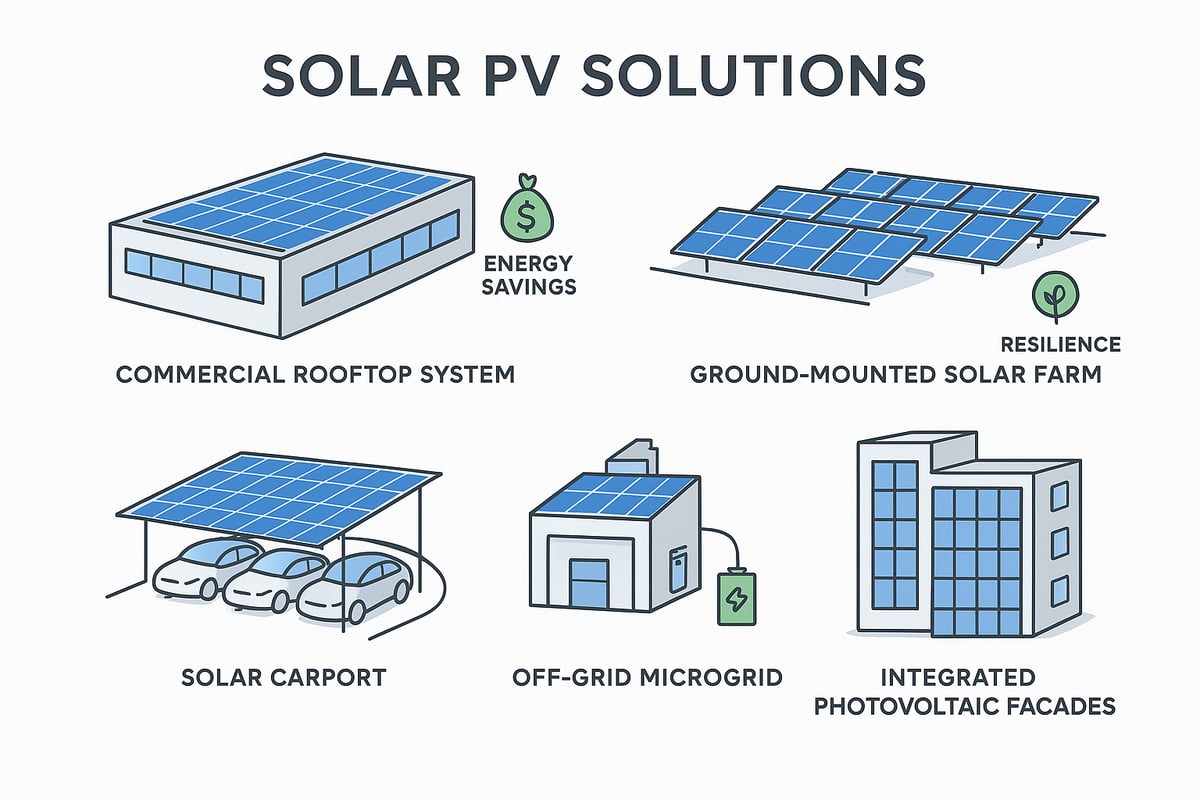
Rooftop solar pv solutions remain the most popular choice for commercial, industrial, and residential buildings in 2026. They offer a direct way to harness renewable energy without consuming additional land.
Key considerations include roof orientation, structural integrity, and shading. South-facing roofs with minimal obstructions yield the best results, but advances in panel efficiency have expanded suitability for a wider range of buildings.
For example, the LVS Ascot school project demonstrates how educational facilities are reducing both energy bills and emissions with rooftop solar pv solutions. These systems can be scaled to match energy needs, offering flexibility for future growth.
Ground-mounted solar pv solutions are ideal for sites with ample open space, such as rural estates, solar farms, and large commercial operations. These arrays can be optimally angled and spaced for maximum generation, independent of building constraints.
However, planning and land use present unique challenges. Developers must consider local biodiversity, visual impact, and grid connection requirements. Community energy projects, for instance, often use ground-mounted systems to deliver shared benefits and support local authority sustainability targets.
Such large-scale solar pv solutions are increasingly vital for regions aiming to decarbonise their energy supply and achieve net zero goals.
Solar canopies and carports transform parking areas into productive energy assets. These solar pv solutions generate clean power while providing shelter for vehicles, making them especially attractive for commercial and public sector sites.
A standout example is the Yorkshire Building Society’s installation, where solar carports cover 169 parking spaces. Design and installation must account for structural loading, drainage, and maintenance access.
In 2026, solar carports are often integrated with electric vehicle charging, further enhancing site sustainability and supporting the shift to clean transport.
For remote locations, critical infrastructure, or sites seeking resilience, off-grid and microgrid solar pv solutions offer independence from the national grid. These systems pair solar arrays with battery storage and backup generation to ensure continuous power.
Typical applications include rural healthcare facilities, communications infrastructure, and emergency services. Integration with advanced monitoring allows for optimal energy use and reliability.
Learn more about the benefits and technologies behind off-grid solar power solutions for sites where grid connection is impractical or where resilience is paramount.
Building-integrated photovoltaics represent the next generation of solar pv solutions, embedding solar technologies directly into the building envelope. Options include solar tiles, photovoltaic facades, and transparent PV glass.
BIPV systems offer both aesthetic and functional benefits, making them popular for new builds and major refurbishments. Regulatory incentives and updated building codes in 2026 are accelerating adoption, particularly in sectors where design and sustainability are equally important.
By choosing BIPV, property owners can maximise renewable generation while maintaining architectural integrity and meeting future compliance standards.
Embarking on the journey to adopt solar pv solutions in 2026 requires a structured, methodical approach. Each phase, from initial assessment to ongoing performance tracking, is vital for maximising the benefits and ROI of your investment. Below, we break down the essential steps to help you navigate the process with confidence.
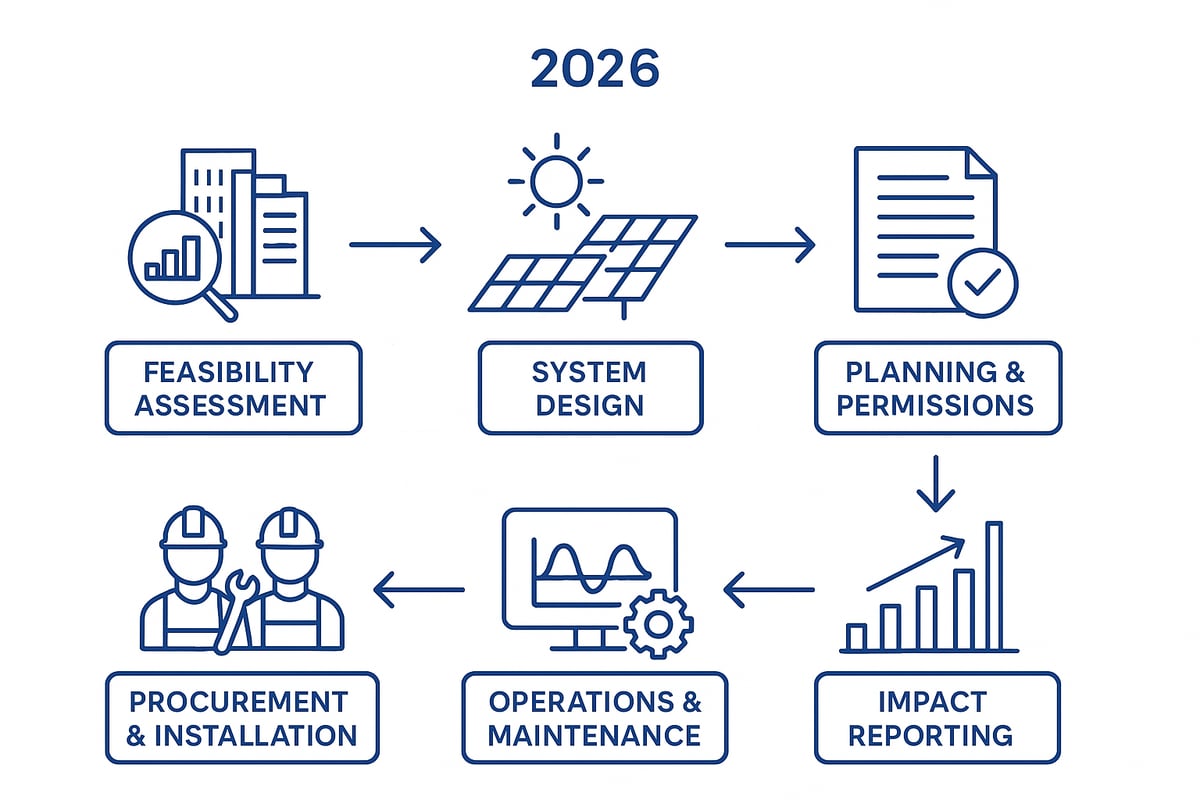
The first step in implementing solar pv solutions is a comprehensive feasibility assessment. This involves analysing your current energy usage patterns and evaluating site suitability. Key factors include roof or land orientation, shading, structural integrity, and available space.
A detailed site survey will identify any physical or technical constraints. Financial modelling is crucial at this stage to estimate potential savings, payback period, and overall ROI. NHS Trusts, for example, use rigorous feasibility studies to ensure each project delivers measurable value and aligns with sustainability targets.
Once feasibility is confirmed, the next phase is system design and technology selection for your solar pv solutions. This step requires matching system size and components to your building’s load profile and anticipated future needs.
Selecting high-efficiency panels, smart inverters, and suitable mounting systems is essential. Consider integrating battery storage or smart controls to boost flexibility and self-consumption. Customised design ensures the system fits seamlessly with your property, maximising both performance and aesthetics.
Securing planning permissions and grid connection is a pivotal stage in deploying solar pv solutions. Planning requirements vary by location and project scale, so early engagement with local authorities is recommended.
Liaising with your Distribution Network Operator (DNO) is necessary for export agreements and compliance. Adhering to building regulations, including health and safety standards, is mandatory. Early preparation helps avoid delays and ensures your installation meets all legal and technical obligations.
With permissions in place, the focus shifts to procurement and installation of solar pv solutions. It is vital to select Tier 1 suppliers and accredited installers who maintain quality standards and offer robust warranties.
Phased installation minimises disruption to daily activities, especially in live environments such as schools or hospitals. For a deeper insight into the process and benefits, see Solar PV installation services. Quality assurance checks at commissioning guarantee optimal system performance and long-term reliability.
Effective operations and maintenance are fundamental to the sustained success of solar pv solutions. Real-time monitoring systems provide instant visibility of performance metrics, alerting you to any anomalies.
Preventative maintenance packages typically include regular inspections, cleaning, and fault resolution. Proactive management helps extend system lifespan, reduce downtime, and safeguard your investment by ensuring consistent, high-yield energy generation.
The final step in the solar pv solutions journey is measuring impact and reporting outcomes. Track energy savings, carbon reduction, and financial returns using digital dashboards and automated reports.
Align reporting with ESG and compliance frameworks, particularly for public sector or grant-funded projects. Regular performance reviews help demonstrate value to stakeholders and identify opportunities for further optimisation, ensuring your solar investment remains future-proof.
Understanding the financial landscape for solar pv solutions in 2026 is crucial for decision makers. Navigating capital outlay, incentives, operational savings, and risk ensures your investment delivers on its promise. Let us break down each aspect so you can approach your solar pv solutions strategy with confidence.
The capital costs for solar pv solutions in 2026 continue to fall, driven by improved manufacturing and supply chain efficiencies. For commercial rooftop systems, typical installed costs range from £800 to £1,200 per kWp, while large-scale ground arrays may be lower per unit due to economies of scale.
Choosing the right financial model makes a significant difference. Businesses may opt for outright purchase, which offers the fastest payback, or select Power Purchase Agreements (PPAs) and leasing to reduce upfront spend. These models help organisations align their solar pv solutions investments with cash flow and risk appetite.
Market forecasts suggest the UK solar sector will see dramatic growth, with capacity expected to surge by 2033. Explore the latest UK solar energy market growth forecast for insight into trends shaping ROI expectations.
Government support remains a cornerstone for those investing in solar pv solutions. The Smart Export Guarantee offers revenue for exported electricity, while various grants support both solar PV and battery storage integration.
Businesses may also benefit from VAT relief and capital allowances, significantly improving project affordability. Eligibility varies by sector and region, so it is worth consulting official sources or a specialist for up-to-date guidance.
Local authorities often provide additional incentives, especially for projects enhancing community resilience or public sector decarbonisation efforts.
Solar pv solutions deliver ongoing value through reduced energy bills and new revenue opportunities. Typical savings for businesses can reach tens of thousands per year, depending on system size and energy usage patterns.
Revenue streams extend beyond bill reductions. Selling surplus electricity to the grid under the Smart Export Guarantee creates consistent, predictable income. Enhanced property values and improved ESG ratings can also unlock favourable financing options.
For property owners, these financial benefits make solar pv solutions a compelling proposition in 2026.
Investing in solar pv solutions involves some risk, but most can be managed with foresight and planning. Common concerns include equipment performance, insurance, grid curtailment, and policy uncertainty.
Mitigation strategies include selecting Tier 1 manufacturers, securing performance guarantees, and ensuring comprehensive insurance coverage. Regular maintenance and monitoring reduce downtime and help maintain expected returns.
Staying informed about policy shifts and grid constraints ensures your solar pv solutions remain resilient and future proof.
Consider a commercial system with 100 kWp capacity. With installed costs of £1,000 per kWp, total capital expenditure would be £100,000. Annual savings could reach £14,000, leading to a payback period of 7 years, especially when factoring in grants and export revenue.
Case studies from public sector entities like Berkshire Healthcare NHS Trust and local authorities demonstrate robust returns, improved energy security, and positive ESG outcomes. These real-world examples underline the tangible benefits of well-executed solar pv solutions.
The future of solar pv solutions in the UK is set for remarkable growth, supported by ongoing innovation and a strong policy push. As the nation aims for net zero, rapid advancements are transforming how solar pv solutions are deployed, managed, and integrated into the wider energy landscape.
By 2030, the UK is expected to surpass 70 GW of installed solar pv solutions, doubling current capacity. This surge will be fuelled by next-generation technologies such as perovskite-silicon tandem cells, which are achieving record efficiencies. AI-driven optimisation and floating solar installations will further expand the reach of solar pv solutions, making them viable for diverse locations. For a deeper dive into emerging innovations, explore advancements in perovskite-silicon tandem cells and the latest innovations in solar technology for 2026. These breakthroughs are set to redefine performance and return on investment.
Solar pv solutions will become central to the evolution of smart grids. The rise of virtual power plants and peer-to-peer energy trading will enable businesses and communities to share, store, and optimise locally generated power. Enhanced grid flexibility and demand-side response will allow solar pv solutions to balance supply and demand more efficiently. As more sites adopt energy storage, seamless integration will help stabilise the grid during peak periods and support greater renewable penetration.
The regulatory landscape for solar pv solutions continues to evolve. Anticipated updates to net metering, grid access, and building codes will make it easier for property owners to install and connect systems. The UK’s net zero strategy and commitments from COP summits are driving stricter carbon reduction targets. Future policy may incentivise hybrid systems that pair solar pv solutions with other renewables. Continued support through grants, export tariffs, and streamlined planning will be crucial for sustained growth.
Opportunities for solar pv solutions are expanding across all sectors. Commercial and industrial facilities can benefit from large-scale rooftop arrays and integrated storage. Public sector organisations, such as schools and hospitals, are leveraging solar pv solutions to cut costs and meet ESG goals. Social housing and community energy schemes are also adopting solar pv solutions to reduce energy poverty and empower local ownership. Innovations in leisure, retail, and education will further diversify the market.
Solar pv solutions are delivering measurable sustainability benefits. They contribute directly to decarbonisation, lower energy bills, and help reduce fuel poverty. Community energy projects foster local engagement and resilience. As solar pv solutions become more affordable and accessible, they are poised to play a pivotal role in achieving national and regional climate goals. The social impact extends to job creation and skills development in the renewables sector.
Decision makers should:
By staying informed and proactive, stakeholders can unlock the full potential of solar pv solutions in 2026 and beyond.